

A Living Heritage Company (EPV)
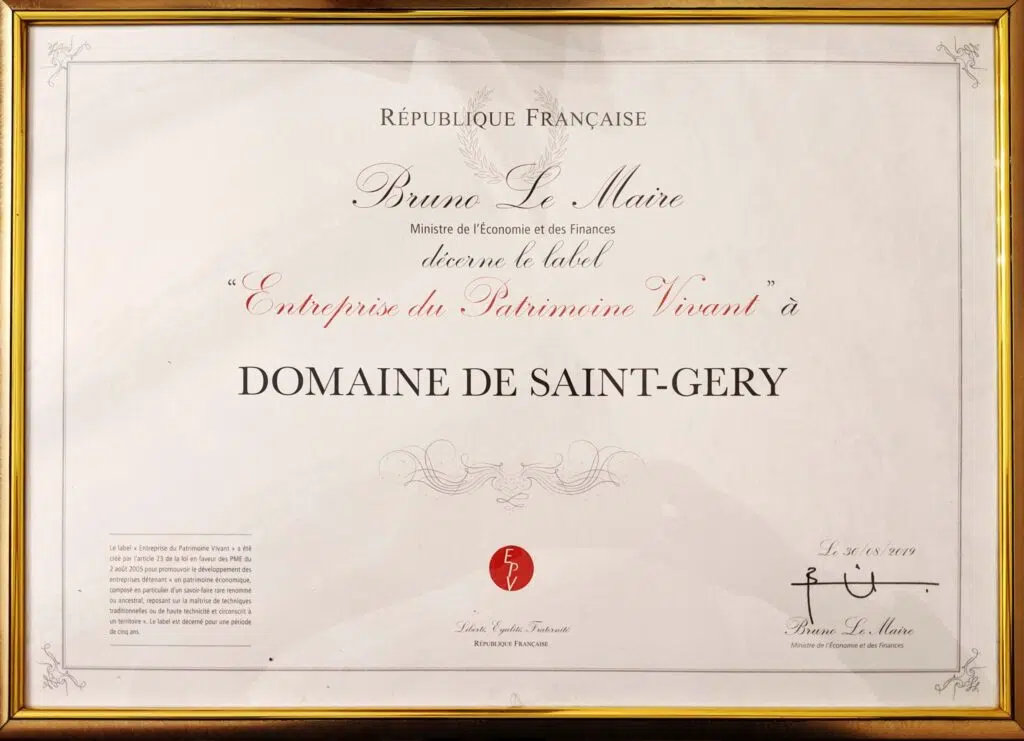
An ‘Entreprise du Patrimoine Vivant’ or EPV is a label that recognizes the excellence of French savoir-faire. It is awarded under the authority of the State, specifically the Ministry of Economy and Finance: ‘It is the only State label awarded to a company for its entire activity, guaranteeing the excellence of its expertise.’
The distinction is granted to companies possessing rare, renowned, or ancestral craftsmanship that no standard training can teach.
Among them: the great luxury houses such as Herm
We have held this label since 2019; it was awarded to us for our unique expertise in ham-making and our approach to gastronomy.

The art of craftsmanship
To create something good, to have a critical sense, to refine a recipe as you go, you must taste. This is our greatest asset at Maison Duler.
We eat what we produce, every day, morning, noon, and night.
And we progress, we refine… and we enjoy.
This is why we apply the greatest care to the choice of every ingredient and the process of each production, down to the smallest detail.
And it is always gratifying to see that the quality of our daily work is recognized and that the constant high standards brought to all our creations are appreciated.
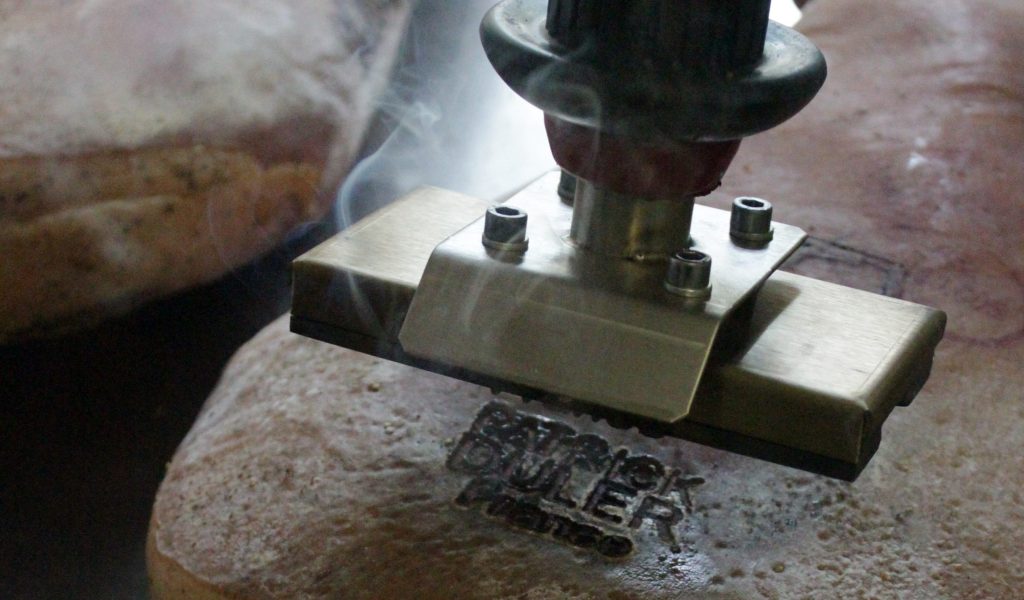
Almost all of our production and crafted goods come from the estate, including the water. This allows us to master the process from start to finish.
We have been practicing this ‘dominivore’ approach (meaning ‘from the estate’) for over 40 years. Do not look for the definition in the dictionary; it is a word we invented, for our global approach is today unique and unprecedented!).
When guests of the estate visit our cellars, one small detail invariably piques their curiosity. Once the door to our treasure trove is opened, an aromatic bouquet fills the air, meeting the senses with the scents of cured meat and fermentation.
The aromas draw visitors into the heart of the room. Dozens of Gascon pork hams hang there, ageing for many months: 20, 30, 50, and even 80 for some of them.
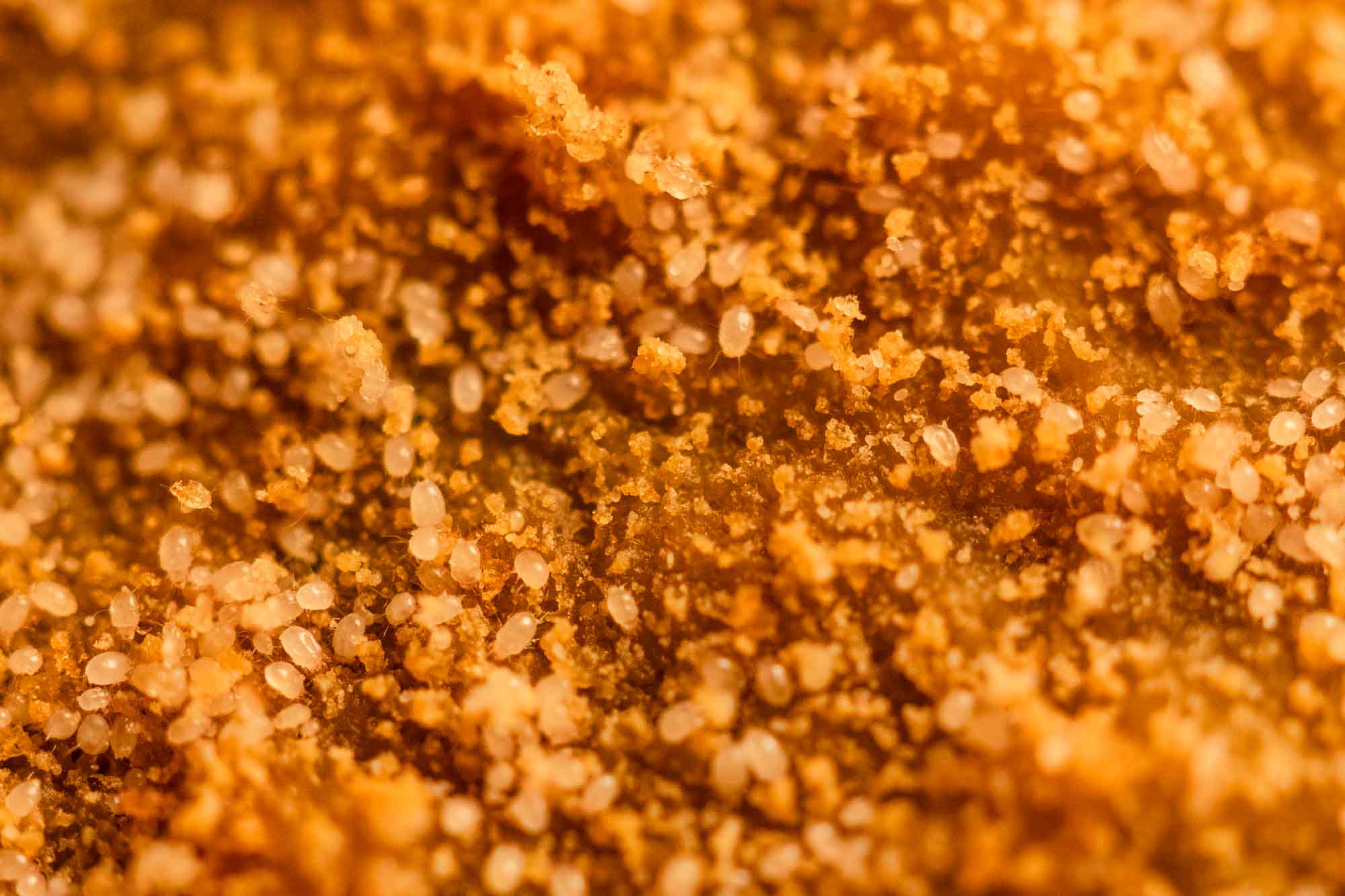
The more observant guests immediately notice a kind of dust settling on the hams. Thinking it is sawdust, they are surprised when it begins to move.
They are cirons, also known as artisons.
Yeasts develop on the rinds of the hams. It is fermentation that enables the ageing process. And as our hams are aged for long periods, after a certain time, the yeasts attract artisons that come to nibble on the rind.
‘Why is there movement on the ham?’ ‘Because there is life!’
These are tiny mites that have long been known. They are among the smallest living beings visible to the naked eye. Not only is this a completely natural process, but it is a true boon for the organoleptic development of the ham.
And then, at the end of the ageing process, a vigorous brushing is enough to rid the leg of all the artisons.
Nibbled away, the rind becomes aerated, allowing the ham to age right to its heart. The result is as exceptional as the uniqueness of the process.
It is difficult to put sensations into words. That said, the one that most often escapes the lips of those who have tasted Duler ham—after the ‘ohhh,’ ‘wow,’ ‘ah,’ and other onomatopoeias—
It is ‘unique’!
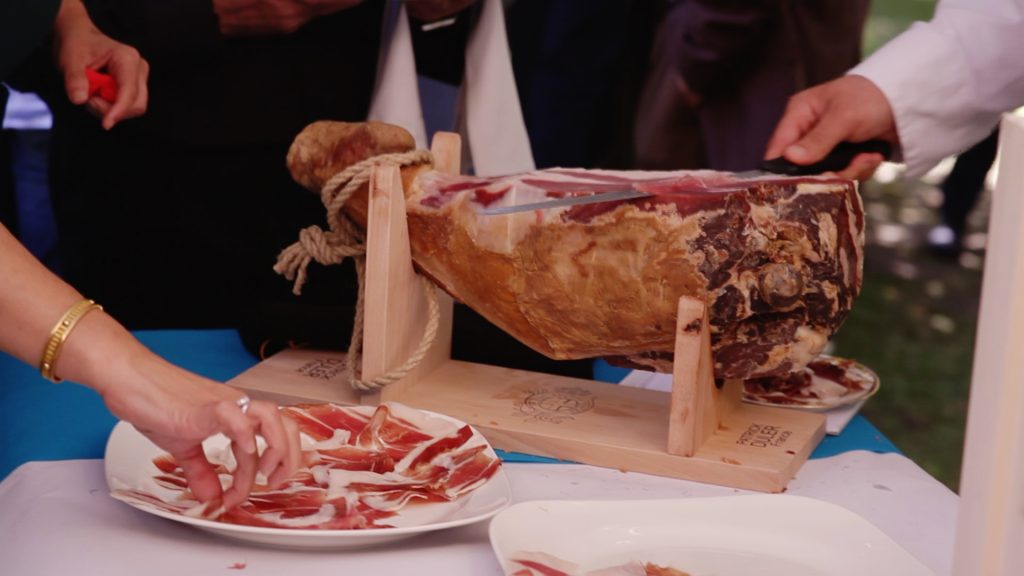
The flavors are so intense, so persistent, that to perceive all their subtleties, one must chew slowly 27 times, letting it melt in the mouth.
It is at this stage that you discover a sapidity of rare depth and unprecedented complexity. Much like fine wines, the flavors do not linger at the front of the palate; they envelop it entirely, coating it. They are by turns shimmering, fragrant, tender, woody, full-bodied, fleshy, raw, blossoming, spicy, mellow, velvety, and vibrant.
It is the full artistry of our production that is revealed, for all to enjoy.
Patrick Duler
Ageing cellars
Contrary to popular belief, ham is not simply dried meat—or at least, not only. Just as cheese is dried and aged milk (to make cheese, 50 to 80% of the water in the milk is removed), the meat of ham or saucisson is dried, but also undergoes the work of yeasts and bacteria that allow for preservation and the development of extraordinary aromas.
This is the crucial importance of ageing. Ageing takes place primarily in cellars with relatively high humidity, which allows the yeasts to thrive.
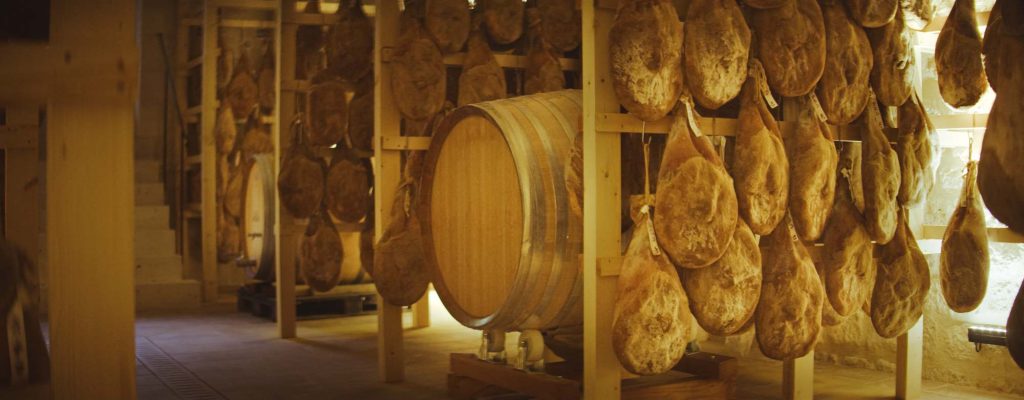
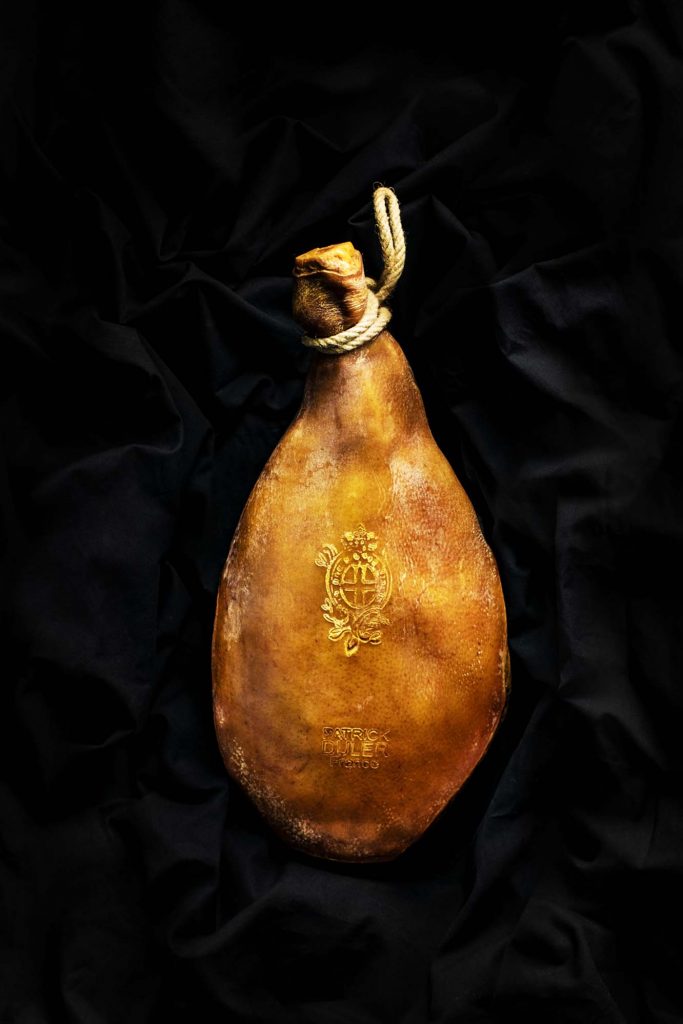
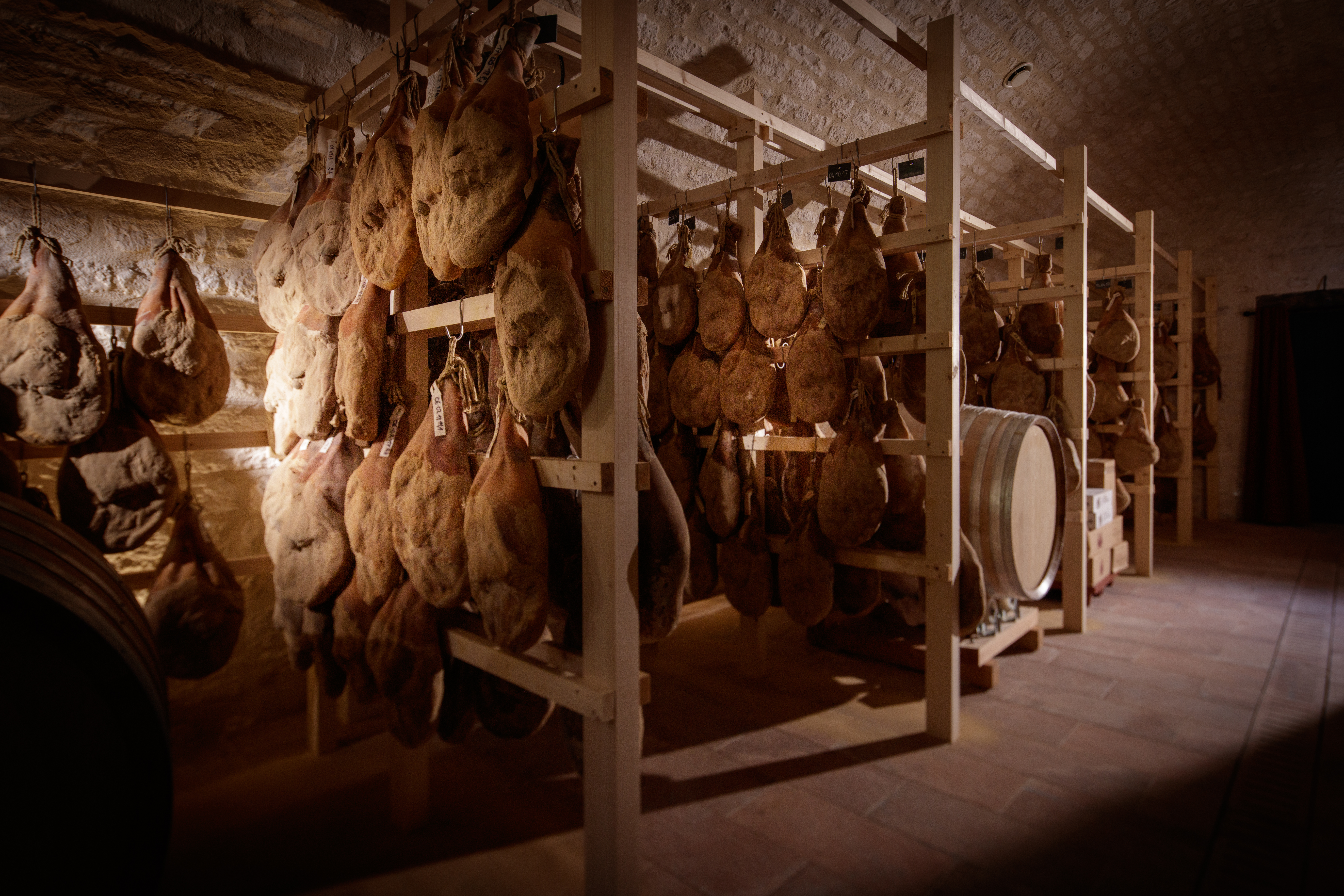

Our hams are aged on the estate. Every day, we visit the ageing cellars.
Each week, we rub dozens of hams with Armagnac.
Each month, we sort the hams to move them to different cellars.
Every quarter, the hams undergoing ageing are coated with a thin layer of lard to protect them.
Every six months, each ham is weighed and individually examined to monitor its progress.
To deepen our knowledge, we conducted experiments from 2012 to 2017 by ageing hams in winegrowers' cellars across France, from the Southwest to Provence and from Bordeaux to Champagne, by way of the Loire.
Our thanks to the winegrowers who opened their cellars to us throughout France:
- Elian Da Ros in Cocumont,
- Anselme Selosse in Champagne,
- Thierry Germain in Saumur,
- Fabien Jouves in Cahors,
- Eloi D
- Stéphane Derenoncourt in Bordeaux,
- Dominique and Laurent Vacheron in Sancerre,
- Bernard Plageoles in Gaillac,
- Philippe Cohen in Saint-Emilion.
They were kind enough to host these ham-ageing experiments in their cellars.
And guess what?
A ham aged in Champagne was different from a ham aged in Bordeaux.
From this unique experience, we identified the ideal cellar characteristics for perfect maturation (humidity, ventilation, height, spacing) of the ham. We then adapted and built our own cellars to master the process from start to finish.
Exacting standards
Throughout the year, we prepare all our products and preparations here—daily fresh foie gras, Muscovy duck breasts, truffles, and Gascon pork hams and cured meats—in strict compliance with the most rigorous hygiene standards following the Hazard Analysis Critical Control Point principles, while eschewing all chemical additives.
The HACCP method was developed in the 1960s for NASA to ensure food safety for astronauts. It involves analysing hazards at each stage of production to control them, ensuring the safety of all foodstuffs.

HACCP is a principle that all restaurateurs have been required to apply since 2011 to ensure food safety in their establishments.
It is a method for preventing risks to guests and consumers.
The purpose of this system is to control, eliminate, or reduce consumption-related hazards, while ensuring the purity and quality of the food.
This method was designed to give restaurateurs perfect control over every critical point in their operations. It has now become a standard. HACCP has notably been formalised within the European Union under Directive 93/43/EC on the hygiene of foodstuffs.
Beyond the estate's own produce, we require the same level of rigour from our poultry suppliers—for chickens and ducks—as we do for our Gascon pork.
For example, with Nicolas and his agroforestry poultry, we immediately found common ground.
His guinea fowl, chickens, capons, and poulardes are raised under trees using a mobile coop system, following the same philosophy as the one we use for our own hens (though on a much larger scale). Nicolas has extended the rearing periods specifically for us to 150 days, instead of the usual 100, to produce fleshier, richer poultry with even more flavourful meat.
And we have begun serving his exceptional poultry at the restaurant.
This poultry—like our Gascon Pork, which is also raised under trees by organic farmers—has now become a cornerstone of our restaurant menu.