


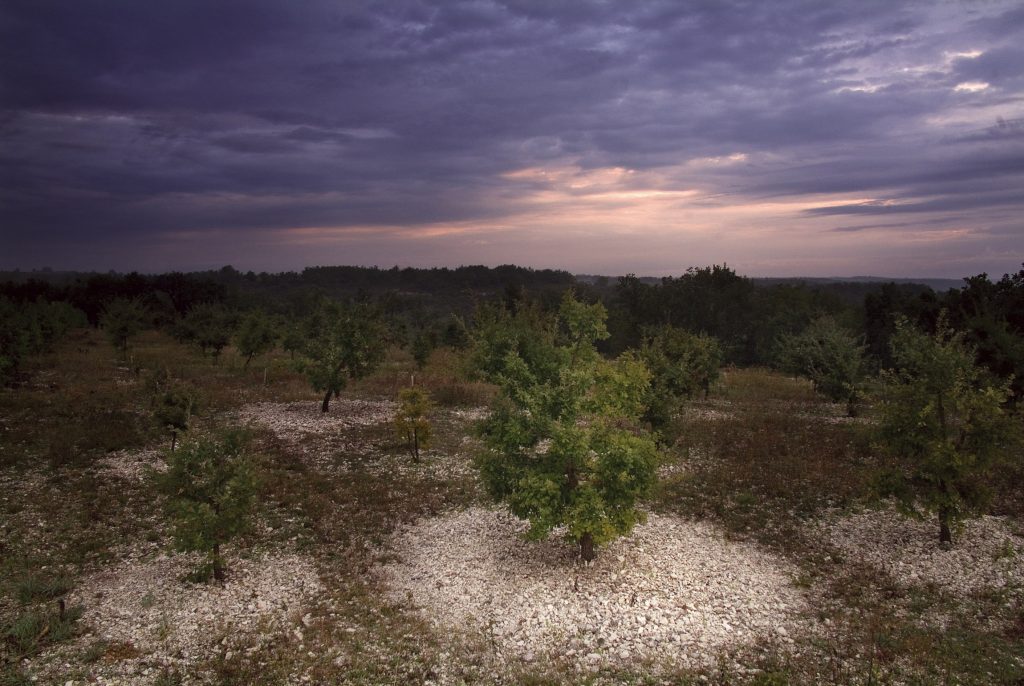
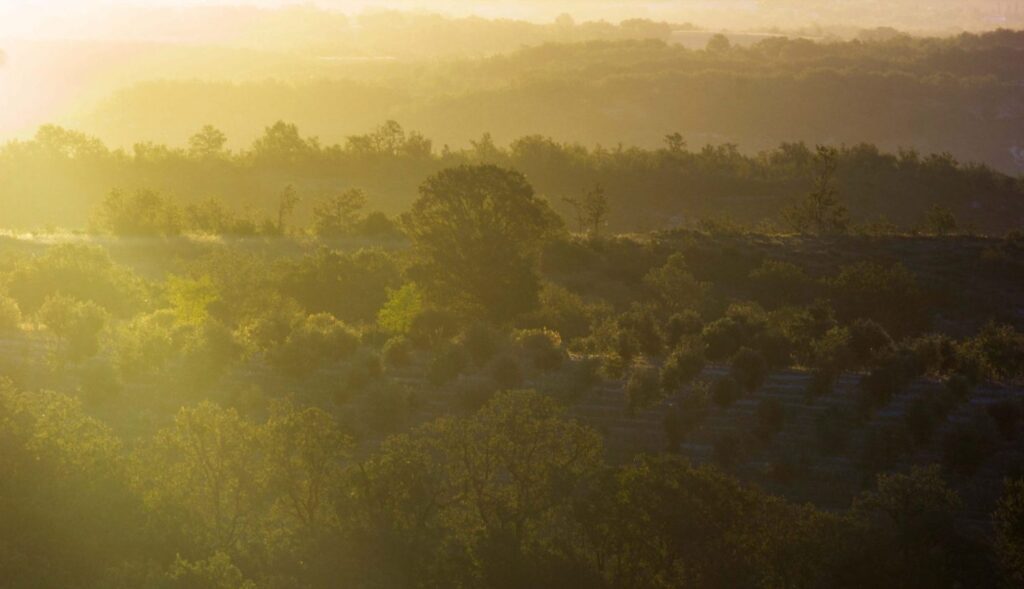
Les truffières du Domaine de Saint-Géry sont situées sur des terres arides et pauvres, il s’agit de plateaux du Quercy Blanc formés de calcaire d’origine lacustre remontant à 30 millions d’années sur lesquels les chênes truffiers poussent naturellement.
Aussi, depuis 1989, chaque année, nous plantons sur ce causse du Quercy Blanc, des plants de différentes espèces.
Des chênes bien sûr, chênes verts, chênes pubescents, chênes kermès, chênes cerris et aussi des noisetiers communs ou de Byzance. Tous ces plants sont mycorhizés par la truffe melanosporum.
Quand ramasse-t-on les truffes ?
De fin décembre à début mars.
Au fil des années, nous avons mené (et menons encore) de multiples essais, sur les associations avec d’autres cultures (lavande, vigne, blé truffier,…), la taille, l’espacement des arbres, les engrais verts (implantation de lotier, sainfoin, …), le travail du sol, le pâturage… Ce qui fait de cette truffière un terrain d’expérimentation grandeur nature unique en France.
La truffe est un champignon pionnier, qui est long à se développer et qui a besoin de lumière. Si vous laissez faire, l’arbre fera trop d’ombre avant que la truffe ne soit prête à produire.
Notre travail « d’éleveur » de truffe consiste d’une part, à favoriser la vie du sol pour qu’il fournisse la meilleure nourriture à la truffe et le meilleur environnement pour qu’elle se sente bien.
D’autre part, il consiste à entretenir l’arbre sans le stresser pour que la symbiose avec la truffe fonctionne en laissant toujours la lumière arriver jusqu’au sol.
Ce n’est pas une culture cartésienne, c'est la nature qui dicte ses règles et non pas l’homme.
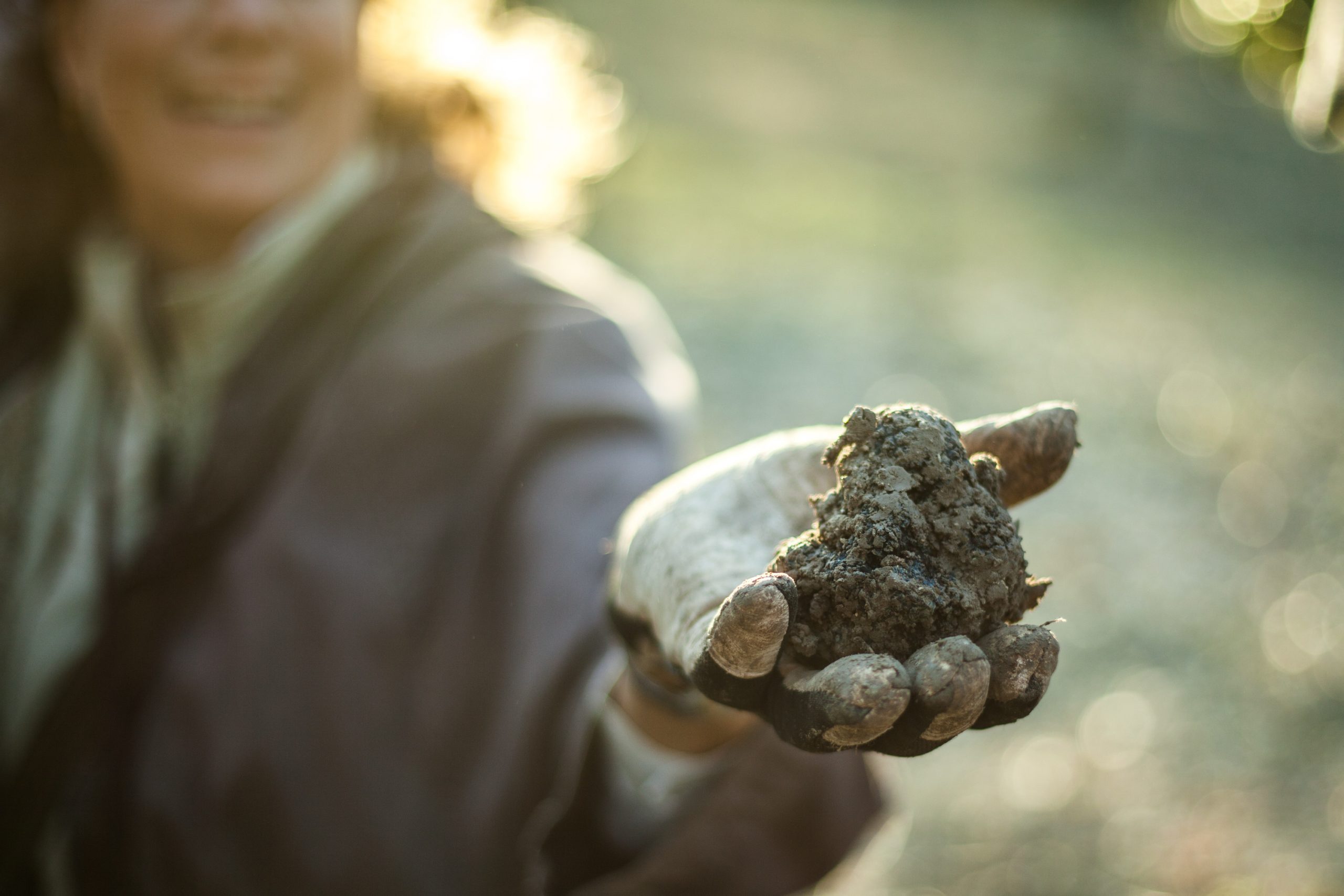
Cette démarche vise à créer un écosystème où les végétaux vivent en symbiose, où le sol est vivant (indispensable pour produire de la truffe), réduisant voire annulant les risques de maladie.
Objectif : faire de la truffe, du blé, de la vigne sans aucun traitement.
La truffe est invisible parce qu’elle loge sous terre, mais elle « marque » son territoire, et c’est elle qui façonne son paysage.
Les terrains où elle se développe, sont reconnaissables entre tous. Il faut scruter le paysage pour découvrir son jardin…
La main de l’homme est une condition nécessaire, mais pas suffisante. La truffe a besoin d’alliés « sur le plancher des vaches ». Ainsi, les ovins ou les chevaux font le « ménage », en débarrassant le terrain de la broussaille et les arbres de leurs excès de ramure.
En faisant cela, ils lui garantissent la lumière. Et ce sont eux, aussi, qui nourrissent la terre où elle aime grandir. Le premier rôle de l’homme consiste en fait à les aider à faire ce travail.
Mais la truffe a également d’autres précieux complices dans le sous-sol : les vers de terre, qui passent leur temps à aérer sa demeure.
En toute logique, la truffe fuit les terrains où tout cela se passe « à l’envers » : mécanisation à outrance, engrais chimique, pesticides, aucune présence animale, etc.
Lorsque chacun fait son ouvrage, la truffe appose enfin son « sceau » : c’est « le brûlé », ce rond au pied des arbres, sans herbe. Là, on peut se dire : nous sommes chez elle.
Attention ! Cela ne signifie pas qu’elle est là, mais elle peut arriver à tout moment … Selon son désir.
Voilà 30 ans que nous l’observons et que nous essayons de l’apprivoiser sur nos truffières.

Lexique de la truffe
Le « brûlé »
Trace ronde au sol autour de l’arbre truffier où l’herbe pousse peu ou pas du tout, délimitant les zones de développement naturel de la truffe. C’est l’indicateur visuel de la colonisation des mycorhizes de la truffe.
Caver, cavage
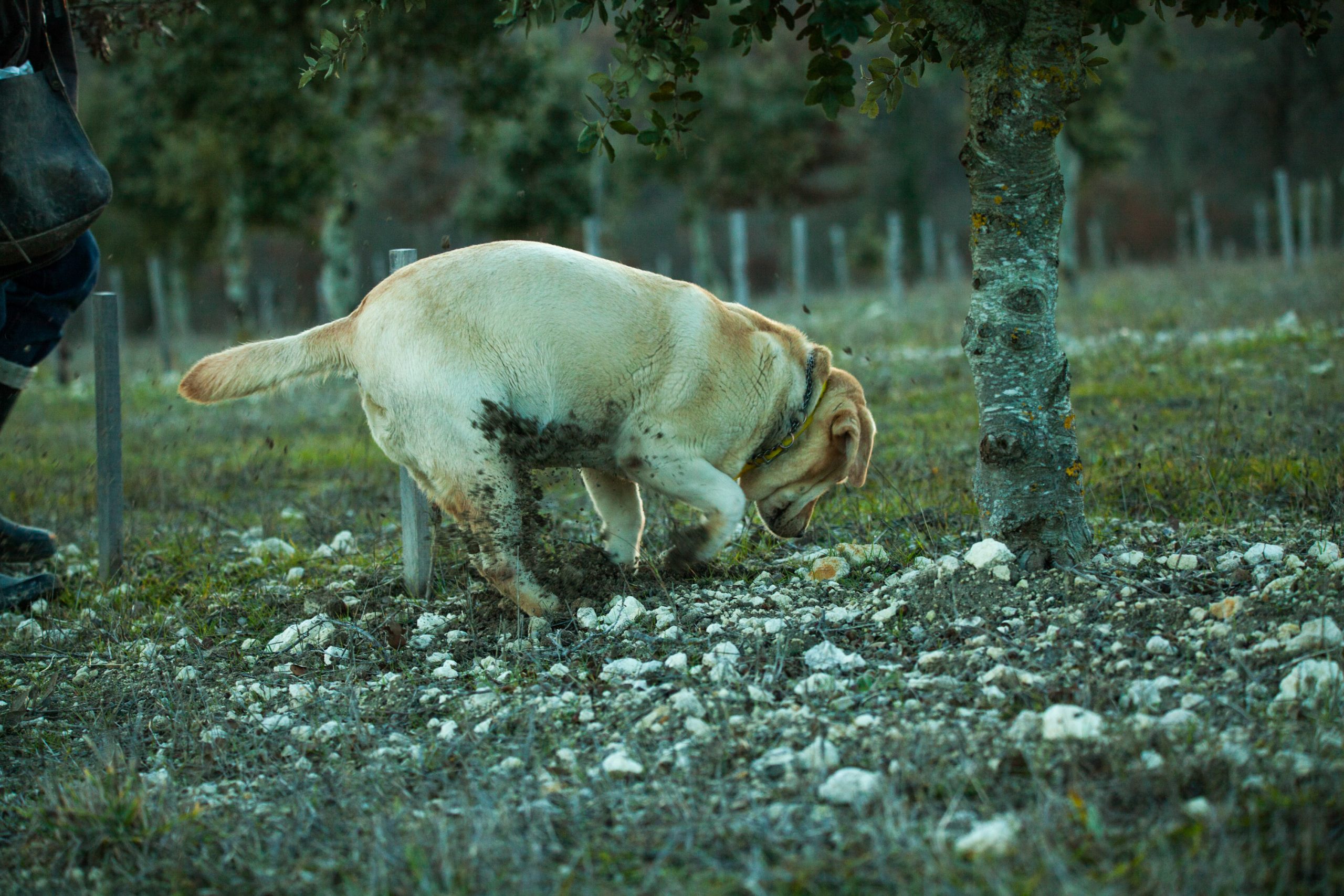
Récolter la truffe à l’aide d’un chien, d’une mouche ou d’un cochon. La saison de la truffe noire est de fin décembre à début mars.
Gléba
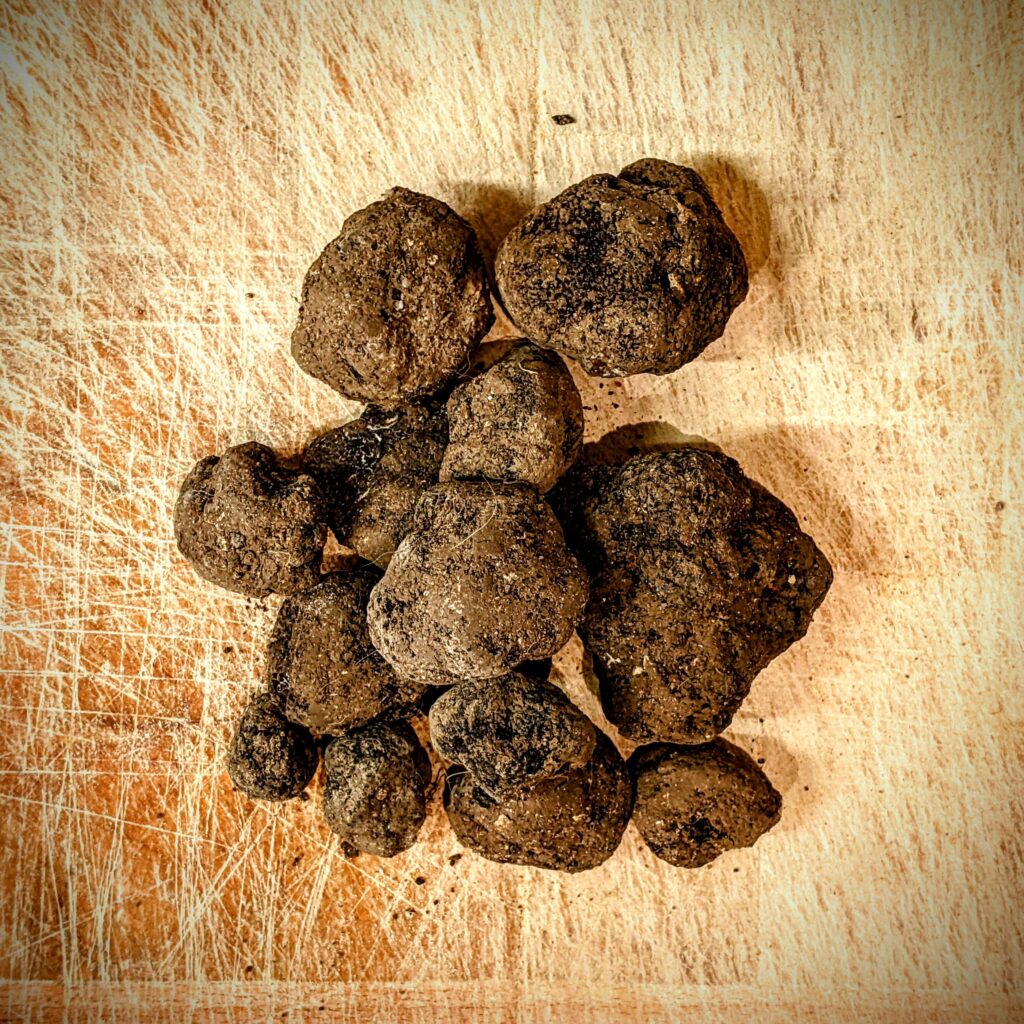
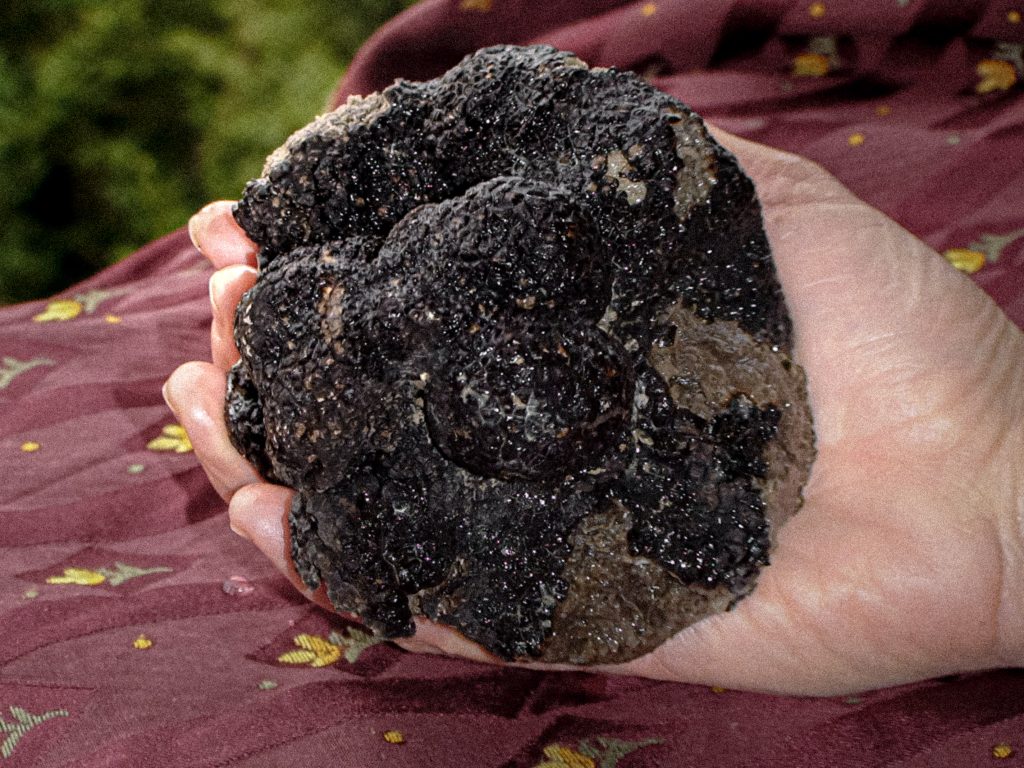
Partie intérieure de la truffe alternant zones stériles (blanches) et fertiles (noires).
Péridium
« peau » ou « écorce » de la truffe, c’est la partie superficielle et rugueuse
Canifer
Inciser à l’aide d’un couteau la truffe pour s’assurer de sa qualité.