


Biodiversity
A living estate in balance is one that embraces biodiversity: crop association, wooded areas, wetlands, and pastoralism.
When our guests walk the estate, they often tell us they do not recognise our wheat fields, as they are interspersed with young sunflowers, bird’s-foot trefoil, broad beans, sainfoin, clover, and wild orchids.
Greater variety brings more pollinators and beneficial insects, fewer diseases, and a palette of colours worthy of the Impressionists, adds Pascale, drawing on her studies at the École du Louvre.
Golden calyxes, white, mauve, or blue flowers: we also remember that most are edible and possess medicinal properties.
Across the estate, we have planted over 4 kilometres of diverse hedgerows combining: large trees (Montpellier maple, holm oak, lime, ash...), fruit trees (redcurrant, blackcurrant, raspberry, prunus, hazelnut...), shrubs (rockrose, Spanish broom, tree medick, boxwood...), and aromatics (lavender, thyme, rosemary...)
We manage our woodlands through selective thinning, excluding any clear-cutting to preserve diversity and ensure the forest's natural renewal.
Thus, we heat the estate with our own wood and use RCW (ramial chipped wood) as a natural fertiliser to enrich the kitchen garden.
To maintain equilibrium, we preserve natural wetlands—left largely untouched—along with the spring and the two spring-fed lakes.

Preserved grounds
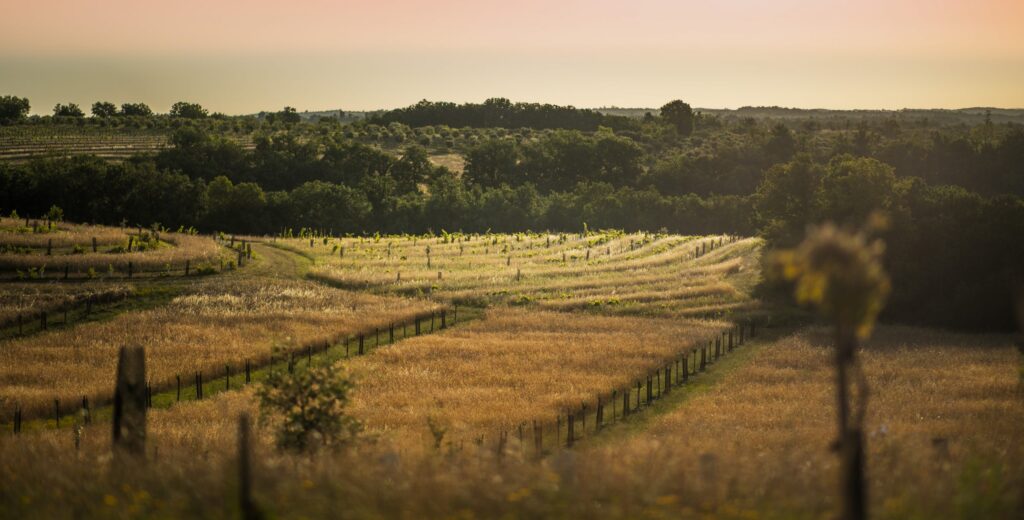
The entire estate is designed as a park for wandering across 70 hectares of preserved and nurtured nature, in the heart of the Quercy Blanc:
These 12 kilometres of private paths allow you, while wandering across the estate:
- To discover the truffle orchards interplanted with vines, wheat, and lavender,
- To stroll through the olive grove,
- To roam the oak and boxwood forests,
- To linger in the wheat fields,
- To admire the "lazy" kitchen garden and orchard and the Italian-style garden,
- To breathe in the scents of the season,
- To listen to the birdsong,
- To marvel at the skies, the clouds, and the light, ever-changing with the hour of your walk,
- To lose yourself near the shaded spring...
And in the garden, by the pool, or on the lake's pontoon, a moment for reading or sunbathing is always encouraged.
La Source aux Loups
Discovered by the Romans, the Source aux Loups supplied the village of Lascabanes with drinking water until the mid-20th century. Abandoned for the municipal supply, we restored it in 2009.
It is nestled in the heart of a century-old boxwood forest where trees exceed 10 metres in height. Its catchment area, located entirely within Domaine de Saint-Géry, consists of oak groves, truffle orchards, and biodynamic grain fields, providing a natural protective setting.
Committed to environmental responsibility, we have harnessed the water from the Source aux Loups, located 800 metres from the house.
To achieve this, we opened a specific trench nearly one kilometre long and connected the water using food-grade piping. The water is then stored in a 5,000-litre food-grade tank and undergoes initial UV treatment against potential bacteria. This is the water you find at the tap, in the swimming pool, and in the lake.
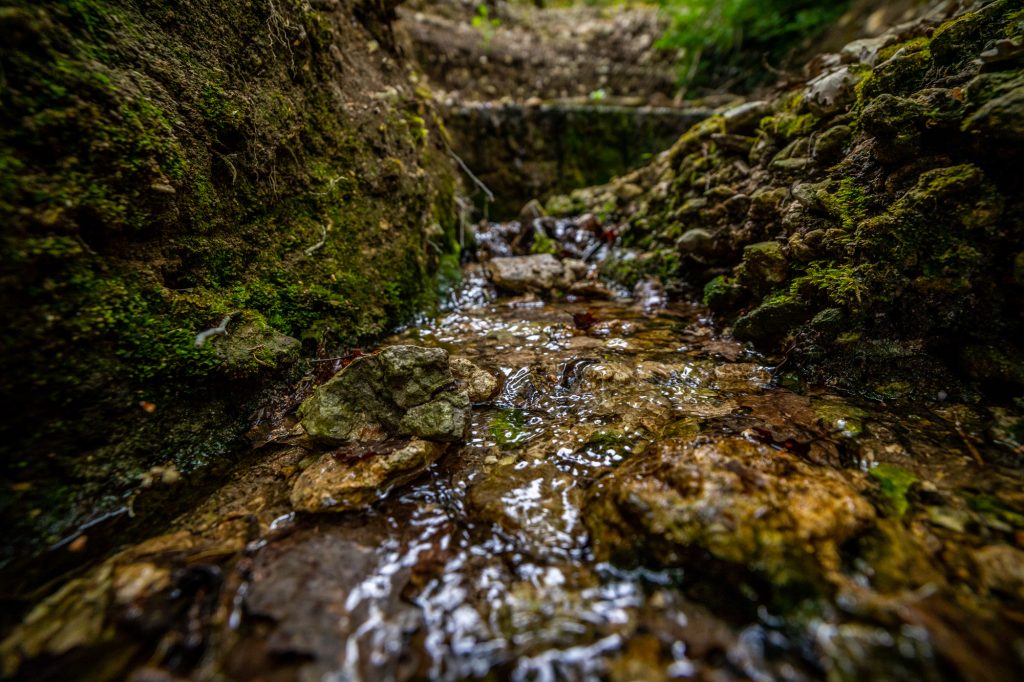
The bottled water undergoes further UV treatment to neutralise any potential external bacterial sources, followed by a Carbon Block active carbon filter to provide "pure" natural water—still or sparkling, carbonated at the time of bottling. This process represented an investment of €24,000.
Each day in your room, you will find a bottle of water from the Source aux Loups to refresh you.
At the restaurant, this chilled water—still or sparkling—is served for €4, contributing to the funding of these investments and the maintenance of the facilities. This approach avoids the environmental impact of transporting commercial mineral waters by truck.